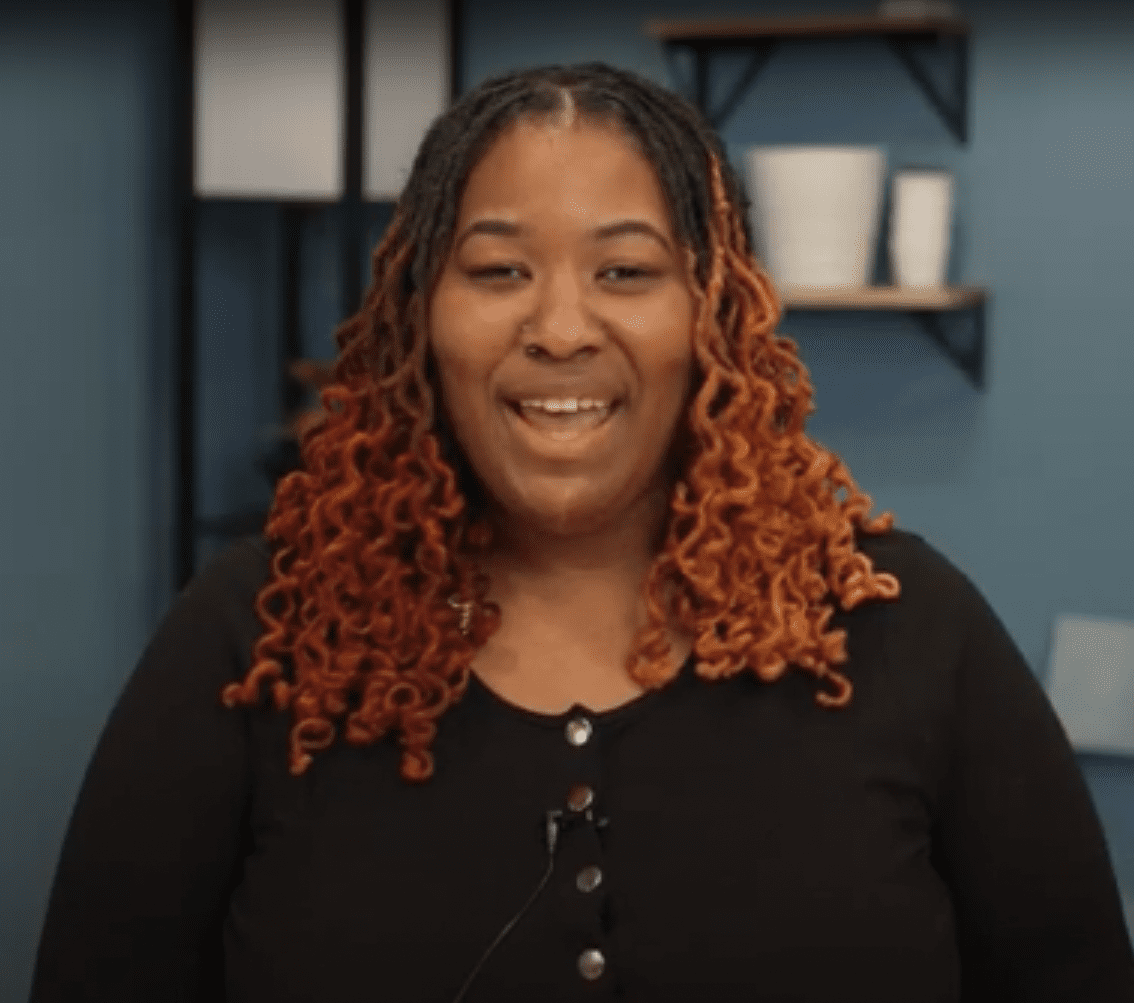



Covenant House New Jersey CEO Julia Einbond urged Senate lawmakers to treat child vulnerability — not just criminal exploitation — as the central crisis.
Covenant House New Jersey (CHNJ) has been serving youth facing homelessness since 1989. While there are many reasons why youth face homelessness, human trafficking is often one of those intersecting reasons. 10 to 20% of the youth we serve have been victims of labor or sex trafficking. Identifying and serving these victims or preventing their victimization in the first place, has become an important part of our mission to serve more youth with better outcomes.
Our impact is being felt not only here in New Jersey, but across North America. On March 3rd, Julia Einbond, CEO, testified before the Senate. A complete transcript of her testimony can be found here along with video of her testimony and those of four others who presented during the hearing; a summary is shown below.
Also, U.S. Senate Democratic Whip Dick Durbin (D-IL), Ranking Member of the Senate Judiciary Committee, provided this press release about the hearing.

In addition to our work with youth facing homelessness, CHNJ is designated by the state Attorney General as the statewide coordinator of human trafficking victim services, and has identified and served over 500 survivors of human trafficking in five years — one in four of whom experienced child trafficking.
Brandon’s Story
Einbond opened with the story of a youth she called Brandon — details altered to protect his privacy, but whose path was painfully familiar. Removed from his mother’s care at four, he was placed in a children’s shelter marked by abuse. By seven, he was selling drugs. As a teenager, he was forced to move crack cocaine for a dealer who controlled him through violence; when he once miscounted money he owed, the punishment left him hospitalized with metal pins in his shoulder. He was arrested multiple times.
Not once was his trafficking identified. Every encounter with law enforcement, every hospitalization, was a moment when a trained eye might have recognized a child being controlled and exploited — not a young criminal. No one did. It was only when a foster care caseworker transferred him to a new home, hours away, finally breaking the dealer’s geographic grip, that Brandon was able to escape. His trafficking was not identified until years later, when he arrived at CHNJ as a young adult experiencing homelessness.
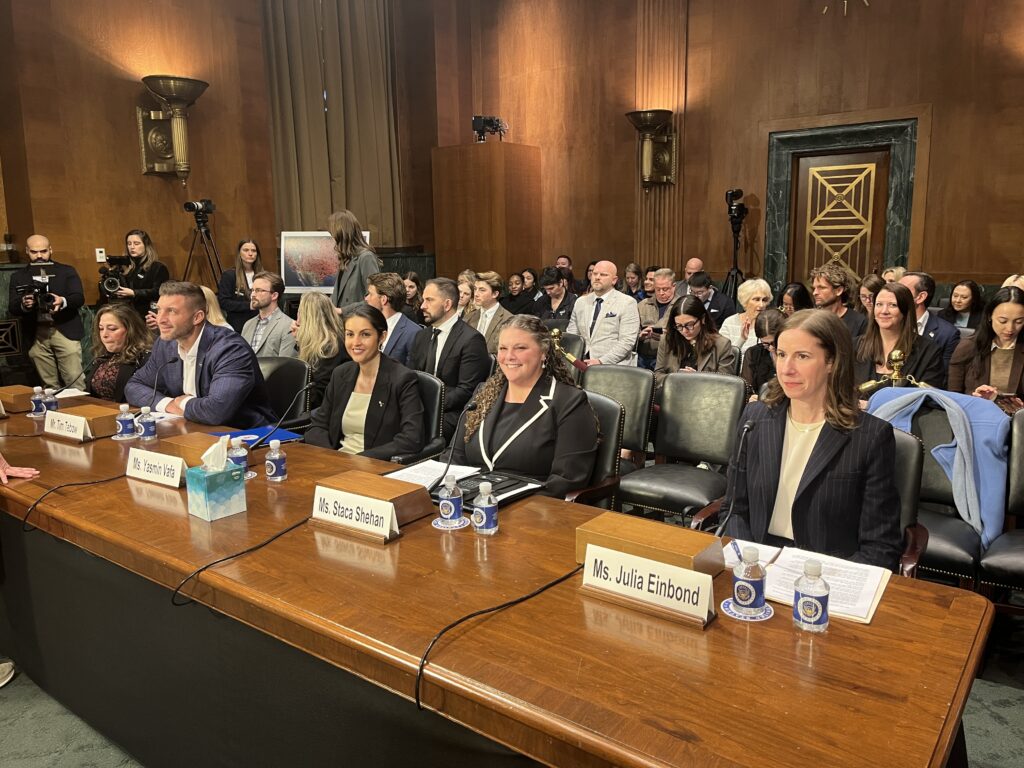
The story has a rare ending. The last time Einbond saw Brandon, he was working, stably housed, had saved over $4,000, and was waiting to sign the lease on his first apartment. “Brandon’s story is not exceptional,” she told the subcommittee. “It is a blueprint — a blueprint for how children fall through every gap we have failed to close, and how the consequences of that failure compound across a lifetime.”
Three Things Congress Must Understand
“There are three things this Subcommittee must understand to make progress against child trafficking: vulnerability drives it, early identification stops it, and services at every stage are essential to combating it. — Julia Einbond, CEO, Covenant House New Jersey
Vulnerability drives trafficking. Children who lack housing, family support, and safe community connections are traffickers’ deliberate targets — children systems have already failed. “If we want to stop trafficking before it starts,” she said, “we must treat vulnerability as the crisis.” Second: identification is intervention. Validated screening tools already exist; what is missing is the will to deploy them at scale across juvenile justice, child welfare, schools, and shelters.
The third: services save lives, and earlier is better. Covenant House New Jersey is piloting a program with law enforcement to screen for trafficking at arrest and divert survivors to services rather than criminalization. “Children want to know how you can help them,” Einbond said. “Traffickers succeed precisely because they have a ready answer to that question. Service providers have a better answer, and the sooner we can give it, the better we can protect children.”
The Funding Crisis
Einbond also sounded an alarm about funding stability. Covenant House New Jersey experienced a 50% reduction in VOCA-funded human trafficking victim services last year, placing survivor recovery directly at risk. She called on the subcommittee to pass the Crime Victims Stabilization Act, which cleared the House by voice vote in January 2026 and awaits Senate action.
Legislative Priorities
Einbond closed with three specific legislative calls:
Runaway and Homeless Youth and Trafficking Prevention Act (RHYTPA): Reauthorize and modernize the federal Runaway and Homeless Youth Act, prioritizing street outreach to survivors of sexual abuse and trafficking, staff training, and prevention services. Einbond described this as “prevention infrastructure” — reducing the supply of vulnerable youth targeted by traffickers and complementing the subcommittee’s enforcement focus.
Victims of Crime Act (VOCA) Stabilization: Restore funding levels after catastrophic reductions that have destabilized frontline providers across the country.
Frederick Douglass Trafficking Victims Prevention and Protection Reauthorization Act (H.R. 1144): Authorize $35 million annually for housing assistance grants for victims of human trafficking, and support survivor employment, job training, case management, life-skills training, and other wraparound social services — provisions informed directly by Covenant House New Jersey’s work.
“Law enforcement approaches alone have not ended human trafficking. But scalable, well-funded services can accelerate the fight and make it far harder for traffickers to continue violating our laws and our children with impunity.” — Julia Einbond, CEO, Covenant House New Jersey
Einbond ended where she began — with Brandon, now working and saving toward his future — as proof that intervention, even when it comes late, can change the arc of a life. The goal, she made clear,is not to wait until children have survived years of exploitation before reaching them. “The investment is modest,” she told the subcommittee. “The stakes could not be higher.”
Based on written testimony submitted to the U.S. Senate Judiciary Committee, Subcommittee on Crime and Counterterrorism, March 3, 2026