




Human trafficking inflicts violence, threats of violence and coercion on its victims. What’s more, victims are often at risk even when they are trying to get help. And it’s not just from the individuals who are traffickers: because victims are often forced into criminal behaviors, they are at risk of prosecution should they seek help from law enforcement. A record of petty, non-violent crimes can come to light, which often obliges law enforcement to take action against a victim.
Historically, law enforcement has lacked tools or training to identify victims of human trafficking. This is particularly true in cases of labor trafficking, where forced criminality is particularly difficult to detect.
This is now changing, thanks to the development of the QYIT training tool, and an innovative partnership between Covenant House New Jersey and the New Jersey Office of the Attorney General. The S.T.A.R. (Screen, Train, Assist and Respond) partnership is aimed at shifting the focus from prosecution of low-level crimes of poverty to support and services for people who are survivors of human trafficking.
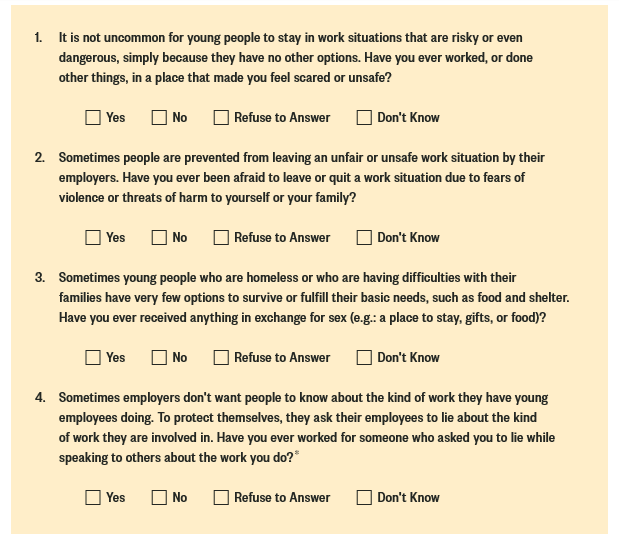
Police officers are trained to administer the QYIT screening tool to identify potential victims at the point of arrest. The QYIT tool is a scientifically validated screener, developed by Covenant House New Jersey in partnership with the Icahn Medical School of Mt. Sinai. The tool uses four simple questions to identify potential victims, without re-traumatizing the victims or asking invasive, personal questions.
If the QYIT tool indicates a potential victim, the person is referred to Covenant House New Jersey, which is the state-designated point of entry for human trafficking victim services. Covenant House New Jersey is prepared to offer victims a range of support from shelter to counseling and long-term case management services.

The S.T.A.R. partnership kicked off its pilot phase with the Mt. Laurel Police Department the first to implement the program. The implementation includes training on QYIT and, critically, education about the degree of officer discretion that may be used when assessing eligibility for the program. The pilot phase lasted until August 2025, and now the program can be replicated across the state of New Jersey, and serve as a model for the rest of the country.